In Summary
- Fresh Ginger (Shengjiang) and Dried Ginger (Ganjiang) come from the same root but are therapeutically distinct — one disperses outward, the other consolidates inward. Using them interchangeably is a clinical error.
- The “Upper Heat, Lower Cold” pattern — brain overstimulated, gut under-activated — is not a metaphor. It describes a real physiological dysregulation increasingly common in sedentary, screen-intensive modern life.
- Fresh Ginger’s anti-nausea mechanism is among the best-clinically-validated in East Asian herbal medicine, with convergence across obstetric, oncological, and motion-sickness research.
- Ginger’s role as a “harmonizer” in classical formulas is pharmacologically significant: its compounds modulate the bioavailability and absorption of co-administered herbs in ways that single-herb research cannot capture.
There is an observation I return to often in clinical teaching, because it captures something about contemporary health that neither Korean nor Western medicine has fully articulated: the modern body is thermodynamically inverted.
The brain — continuously stimulated by screens, information, and cognitive demand — generates and retains excess metabolic heat. The gut — deprived of physical movement, irregular in its eating patterns, and chronically stressed — grows cold and sluggish. This is not metaphor. In Korean medical physiology, the upper and lower burners are meant to maintain a dynamic thermal equilibrium. When the head runs hot and the center runs cold, the consequences are predictable: insomnia, cognitive fog, poor digestion, low energy, and a persistent sense of being both wired and depleted simultaneously.
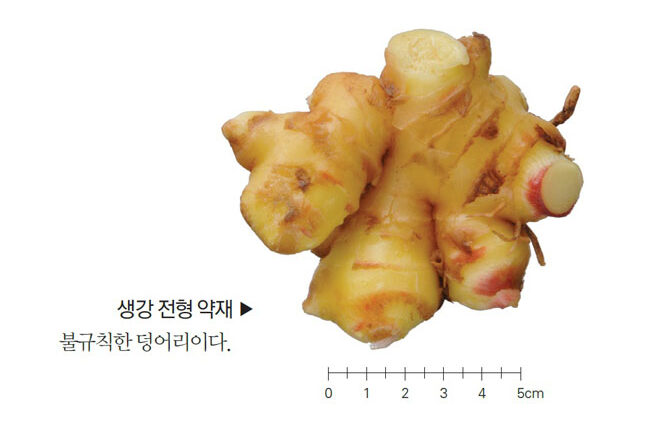
Fresh Ginger — Zingiberis Rhizoma Recens, or Shengjiang (生薑) — addresses this inversion with a clinical precision that I find consistently underestimated, even among practitioners who use it regularly.
The First and Most Important Distinction: Fresh vs. Dried
Fresh Ginger and Dried Ginger (Ganjiang, 乾薑) originate from the same plant — Zingiber officinale Roscoe. They are not the same medicine.
The difference is not merely one of degree. It is directional.
Fresh Ginger possesses a dispersing, outward-moving nature. It targets the exterior and the upper portions of the digestive system — releasing the exterior during early cold patterns, descending rebellious Stomach Qi to stop nausea, and warming the Lung to resolve cold-phlegm cough. Its action is dynamic and transient.
Dried Ginger has a concentrating, inward-sinking nature. It penetrates to the deeper layers of the Middle and Lower Burners, reviving Yang Qi when chronic cold has taken hold in the Spleen and Stomach. Its action is more sustained, more warming, and more appropriate for constitutional cold deficiency.
In classical prescribing, choosing the wrong form produces predictable failures. A patient with acute nausea from cold invasion needs Shengjiang’s dispersing action. A patient with chronic Spleen Yang deficiency needs Ganjiang’s concentrating warmth. Substituting one for the other is not a minor adjustment — it is a different clinical intervention entirely.
1. Releasing the Exterior: The Cold and Flu Application
Fresh Ginger’s foundational indication is the early stage of exogenous cold invasion — what patients experience as the onset of a cold or flu with chills, mild fever, absence of sweating, and nasal congestion without significant internal heat signs.
At this stage, the pathogen is still in the body’s outermost defensive layer (Wei Qi). The therapeutic objective is to support the body’s natural expulsion mechanism through gentle diaphoresis — not to suppress symptoms, but to assist the physiological process that resolves the pathogen.
Fresh Ginger accomplishes this through its pungent, warming nature, which mobilizes Wei Qi and promotes the mild sweating necessary for exterior resolution. In this role, it is frequently paired with scallion (Cong Bai) in simple home preparations, or with Guizhi in more formal classical formulas. Its action is supportive rather than aggressive — appropriate for the early stage precisely because it does not deplete what the body needs to complete the process itself.
2. Descending Rebellious Qi: The Anti-Nausea Mechanism
Of all Fresh Ginger’s clinical applications, its effect on nausea and vomiting has accumulated the most rigorous external validation — which makes it a useful case study in how classical empirical observation and modern pharmacological research can converge.
The classical mechanism: Stomach Qi normally descends. When it rebels upward — from cold invasion, pregnancy, motion, chemotherapy, or postoperative states — the result is nausea and vomiting. Fresh Ginger warms the Stomach and directs Qi back downward.
The biochemical correlate: gingerols and shogaols in Fresh Ginger act on 5-HT3 receptors in the gastrointestinal tract — the same receptor pathway targeted by ondansetron and similar antiemetic drugs — as well as on substance P pathways involved in the vomiting reflex. Multiple randomized controlled trials have demonstrated efficacy for pregnancy-related nausea, chemotherapy-induced nausea, and postoperative nausea, with a favorable safety profile.
What is clinically significant here is not just that Ginger works, but that the mechanism the classical framework predicted — warming and descending rebellious Stomach Qi — maps onto a real receptor-level interaction. The frameworks are describing the same phenomenon in different languages.
3. Warming the Lung and Resolving Cold-Phlegm Cough
Fresh Ginger’s warming action extends naturally to the Lung — the organ most vulnerable to cold and damp invasion from the exterior. When cold impairs the Lung’s dispersing and descending functions, the result is cough with thin, white, watery phlegm, accompanied by chilliness and absence of thirst.
This pattern — cold-phlegm obstructing the Lung — responds poorly to cooling, moistening treatments, which are often the default in Western approaches to cough. Fresh Ginger’s warming, drying action addresses the underlying pathogenic mechanism directly, while its dispersing nature helps restore the Lung’s capacity to open the exterior and regulate fluid metabolism.
In formulas like Xiao Qinglong Tang (小靑龍湯), Fresh Ginger works alongside Ephedra, Pinellia, and other herbs to clear cold-phlegm from the Lung with an efficiency that none of the individual herbs achieves alone — which brings us to one of Ginger’s most underappreciated functions.
4. The Harmonizer Role: Why Ginger Appears in Almost Everything
Fresh Ginger appears in a remarkable proportion of classical formulas — far beyond its direct therapeutic indications. This is not coincidence. The classical tradition assigns it a specific function as a harmonizer (調和藥): an herb that moderates the toxicity of other herbs, facilitates their absorption, and protects the Stomach and Middle Burner from the potential harsh effects of more aggressive agents.
This role has a modern pharmacological interpretation. Ginger compounds influence gastric motility, gastric acid secretion, and intestinal absorption rates in ways that alter the bioavailability of co-administered compounds. The classical observation that Ginger “neutralizes the harshness” of certain herbs corresponds, at least partially, to measurable effects on how those herbs are processed by the gastrointestinal system.
This is clinically important because it means that removing Ginger from a classical formula — or substituting dried Ginger when fresh is indicated — can alter not just Ginger’s direct contribution but the behavior of the entire formula. The harmonizer function is not decorative. It is structural.
5. The Upper Heat, Lower Cold Pattern in Clinical Practice
Returning to the central clinical observation I opened with: the thermodynamic inversion of the modern body.
In Korean medical terms, the ideal state is one where Heart Fire descends to warm the Kidneys, and Kidney Water ascends to cool the Heart — a continuous circulatory dynamic that maintains thermal equilibrium between the upper and lower portions of the body. When this dynamic fails — when upper heat accumulates and lower coldness develops — the clinical presentation is one I encounter with increasing frequency: restless mind, poor sleep, anxiety, combined with sluggish digestion, cold extremities, low motivation, and fatigue that sleep does not resolve.
Fresh Ginger’s warming of the Middle Burner — the pivot between upper and lower — helps restore this circulation. By activating the Stomach and Spleen’s transforming and transporting functions, it supports the downward movement of heat that has accumulated in the upper burner, while simultaneously warming the cold lower burner that was unable to receive it.
This is not a mechanism you will find in a pharmacology textbook. But it is a clinically coherent account of why patients with this pattern often respond to Ginger — as a culinary habit, as a tea, or within appropriately chosen formulas — in ways that exceed what simple anti-nausea or anti-inflammatory properties would predict.
Constitutional Considerations
In the Eight Constitution Medicine framework, Fresh Ginger’s warming, dispersing profile aligns most favorably with Soeum (少陰) constitutional types, who tend toward cold deficiency and sluggish Middle Burner function. For these patients, regular use of Fresh Ginger — whether culinary or medicinal — provides genuine constitutional support.
Soyang (少陽) types require more caution. Fresh Ginger’s warming nature can exacerbate existing internal heat in constitutions already prone to Yang excess. When nausea or digestive symptoms arise in Soyang patients, the cause is more likely heat-induced Stomach disharmony than cold — and warming with Ginger can worsen rather than resolve the underlying pattern.
This constitutional lens explains why the same cup of ginger tea that relieves one patient’s nausea can aggravate another’s — and why symptom-matching without constitutional assessment produces inconsistent results.
A Note on Culinary vs. Medicinal Use
Fresh Ginger is unusual among medicinal herbs in that its culinary and medicinal uses overlap substantially. This creates a useful clinical opportunity — and a potential source of confusion about form and amount.
Culinary amounts (a few slices in cooking, a cup of ginger tea) provide genuine therapeutic effects for mild, acute presentations in constitutionally appropriate patients. They are sufficient for early cold symptoms, mild nausea, and digestive sluggishness in patients with no significant contraindications.
Classical medicinal use — concentrated amounts within prescribed formulas — is appropriate for more significant presentations and requires the kind of constitutional and pattern-based assessment, by a qualified clinician, that distinguishes effective herbal medicine from generalized wellness advice.
The gap between these two is where most consumer-facing ginger content operates — recommending it broadly as a digestive aid or anti-inflammatory without the constitutional specificity that determines whether it will be useful for a given patient. For patients who fit the profile, it is an excellent tool. For those who do not, it is at best neutral and occasionally counterproductive.
This article reflects the clinical observations and teaching practice of Professor Seungho Baek, Professor of Korean Medicine at Dongguk University College of Korean Medicine, specializing in Pathology and Oncology.
