In Summary
- Guizhi is not simply a warming herb — it is a directional one. Its clinical value lies in its capacity to move Qi and Yang toward the body’s surface, a property no heavier bark can replicate.
- The Guizhi-Shaoyao pairing is one of Korean medicine’s most instructive clinical lessons: opposing forces creating equilibrium, not canceling each other out.
- Guizhi’s action on palpitations and fluid metabolism reveals a coherent physiological logic that modern cardiology and nephrology are only beginning to map.
- Constitutional fit matters more than diagnosis: Guizhi is profoundly therapeutic for some patients and contraindicated for others with nearly identical symptoms.
Of all the herbs I return to most consistently in clinical teaching, Cinnamomi Ramulus — Guizhi (桂枝) — may be the one that best illustrates why Korean medicine requires a different kind of thinking than Western pharmacology.
Western herbal medicine tends to ask: what does this compound do biochemically? Korean medicine asks something prior to that: what direction does this substance move, and in what constitutional context does that movement become therapeutic? Guizhi answers these questions in ways that have occupied classical physicians for over two millennia — and that continue to reward careful clinical attention today.
What Guizhi Actually Is — and Why the Distinction from Rougui Matters
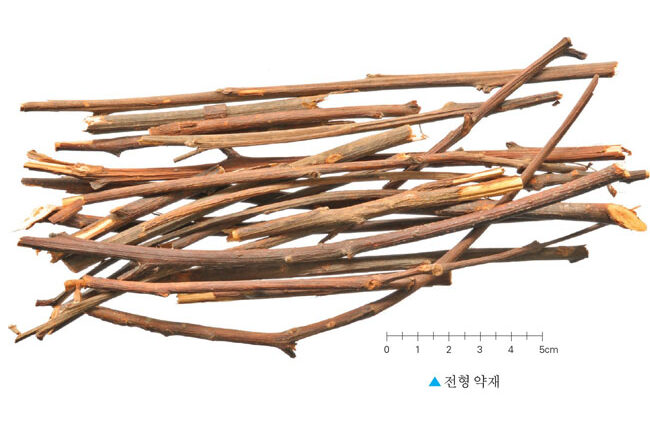
Guizhi comes from the young, slender twigs of Cinnamomum cassia Presl. Rougui (肉桂) — cinnamon bark — comes from the same tree’s thick inner bark. They share a genus, a species, and a characteristic volatile oil profile dominated by cinnamaldehyde.
They are not the same medicine.
Classical texts describe this distinction with precision: Rougui sinks and warms the interior — specifically the Kidney Yang and the lower burner. Guizhi rises and opens the exterior — it governs the Wei (衛) layer, the body’s outermost defensive boundary. This is not metaphor. It reflects a real clinical observation: patients who need deep warming respond to Rougui; patients who need surface-level mobilization and diaphoresis respond to Guizhi. Confusing them produces predictable therapeutic failures.
The directional character of Guizhi — what classical texts call its “ascending and outward” (sheng san) nature — is its defining clinical feature. Understanding this single property explains the majority of Guizhi’s indications.
1. Governing the Exterior: The Primary Indication
Guizhi’s foundational role is managing the body’s response to exogenous pathogenic cold. In the Shanghanlun framework that underlies most East Asian prescribing, the earliest stage of cold invasion targets the Taiyang (太陽) layer — the exterior of the body where Wei Qi circulates.
When this layer is compromised, the characteristic presentation includes fever without relief through sweating, aversion to wind, spontaneous sweating, and a floating, lax pulse. This is not the same as the tight, wiry pulse of excess cold — and the treatment is different accordingly.
Guizhi Tang (桂枝湯) — Guizhi Decoction — addresses this pattern by restoring the regulatory capacity of the Wei-Ying (衛營) interface: the dynamic balance between the body’s defensive exterior and its nutritive interior. Guizhi does not simply suppress the pathogen. It restores the body’s capacity to resolve the conflict itself, using moderate physiological sweating as the mechanism of pathogen expulsion.
This is a fundamentally different model from antimicrobial intervention — and in my clinical experience, it produces good outcomes for uncomplicated viral presentations in constitutionally appropriate patients.
2. The Guizhi-Shaoyao Pairing: A Lesson in Opposing Forces
Guizhi Tang’s second ingredient — Paeoniae Radix Alba (Shaoyao, 芍藥) — is Guizhi’s clinical partner and its conceptual counterweight. Understanding why they are prescribed together illuminates something essential about Korean medical thinking.
Guizhi moves outward and upward. Shaoyao anchors and nourishes inward. One disperses; the other consolidates. In a lesser formulation, you might expect them to cancel each other out. In classical practice, they create a precisely calibrated equilibrium.
When the ratio shifts — more Guizhi, less Shaoyao — the formula moves toward dispersion and exterior resolution. More Shaoyao, less Guizhi — toward interior nourishment and smooth muscle relaxation. The same two herbs, the same formula name, producing therapeutically different outcomes based on proportion alone.
This is the kind of clinical intelligence that cannot be captured by single-compound pharmacology. It requires thinking in relationships, not isolates.
3. Heart Palpitations and the Qi Circulation Logic
One of Guizhi’s less intuitive indications — and one I find clinically underutilized in integrative practice — is its role in managing palpitations and chest oppression.
The classical explanation: Guizhi activates Yang Qi circulation through the chest and Heart channel. When Yang Qi stagnates in the upper burner, the result is oppression, irregular heartbeat, and a sensation of anxiety that patients often describe as sourceless unease.
The modern parallel: cinnamaldehyde and related compounds in Guizhi demonstrate vasodilatory effects and inhibit platelet aggregation in laboratory conditions. This does not fully explain the classical mechanism, but it offers a partial biochemical correlate for why Guizhi consistently appears in classical formulas for cardiac presentations.
In formulas like Guizhi Gancao Tang (桂枝甘草湯) — among the simplest in the classical canon — just two ingredients address palpitations by directly warming and activating Heart Yang. The clinical logic is elegant in its economy.
4. Fluid Metabolism and the Resolution of Water Accumulation
Guizhi’s Yang-activating property extends naturally into its role in fluid metabolism disorders. When Yang Qi is insufficient or obstructed, fluids fail to transform and distribute properly — accumulating as edema, phlegm, or pathological retention in various body cavities.
Guizhi appears in Wuling San (五苓散), the classical formula for water retention with concurrent exterior pathogen involvement. Here it serves a dual function: assisting the Bladder’s transforming function (化氣) to resolve retained water, while simultaneously addressing any residual exterior pathogen. No single Western drug mechanism accounts for this dual role — which is precisely why thinking in terms of physiological direction rather than molecular targets remains clinically useful.
5. Joint Obstruction: Cold-Damp Bi Syndrome
Guizhi’s warming, unblocking properties make it essential in managing cold-damp Bi syndrome — the classical category most closely approximating what Western medicine calls osteoarthritis, rheumatoid arthritis, or fibromyalgia in its cold-predominant presentations.
The clinical picture: joint pain that worsens with cold and damp weather, improves with warmth, and presents with a heavy, stiff quality rather than acute inflammation. The pathological mechanism in Korean medical terms: cold has congealed the meridians, impeding Qi and Blood circulation through the affected joints.
Guizhi’s ascending, warming, and unblocking character directly addresses this. In formulas like Huangqi Guizhi Wuwu Tang (黃芪桂枝五物湯), it works alongside Astragalus to warm the defensive exterior and unblock meridian circulation simultaneously — addressing both the local obstruction and the constitutional vulnerability that allowed it to develop.
6. Constitutional Fit: Who Benefits, and Who Should Avoid It
In the Eight Constitution Medicine framework I apply at Dongguk University, Guizhi’s therapeutic utility is strongly constitution-dependent.
Soeum (少陰, Lesser Yin) constitutional types — characterized by a tendency toward cold, insufficient Yang, and a vulnerable exterior defensive layer — respond to Guizhi with particular reliability. For these patients, Guizhi is not merely symptomatic. It addresses the constitutional tendency that makes them repeatedly susceptible to the conditions Guizhi treats.
Taeyang (太陽) and Soyang (少陽) types with internal heat presentations are contraindicated. Guizhi’s warming, ascending nature will amplify existing heat — producing aggravated symptoms, headache, agitation, and bleeding in the most extreme cases. This is not a failure of the herb; it is a failure to match herb to constitution.
The same clinical intelligence applies to any patient with Yin deficiency, active bleeding, or febrile disease from heat pathogen — all recognized contraindications in the classical literature, and all explicable by the same directional logic. None of this is a basis for self-prescription: which herb suits which person is a determination for a qualified clinician, not a self-assessment.
7. What Two Millennia of Clinical Use Actually Tells Us
Guizhi has been in continuous clinical use across East Asia for over 2,000 years. This is not proof of efficacy in the sense modern clinical trials require. But it is evidence of something meaningful: a clinical community with no financial incentive to preserve ineffective treatments found Guizhi consistently useful enough to include it in the foundational formula canon — and to refine its applications across hundreds of generations of practice.
Modern research is beginning to characterize the biochemical basis of some of these effects. Cinnamaldehyde’s anti-inflammatory, vasodilatory, and antimicrobial properties are documented in laboratory settings. Guizhi Tang has shown immunomodulatory effects in controlled studies. The pharmacological picture remains incomplete.
But incompleteness is not the same as inefficacy. Clinicians who wait for complete mechanistic explanation before using classical herbs with extensive empirical support will deprive their patients of tools that work — sometimes better than anything the pharmacopoeia offers for the same presentations.
Guizhi is one of those tools. Used correctly — in the right patient, at the right stage, with the right pairing — it remains one of the most clinically elegant herbs in the Korean medical tradition.
This article reflects the clinical observations and teaching practice of Professor Seungho Baek, Professor of Korean Medicine at Dongguk University College of Korean Medicine, specializing in Pathology and Oncology.
