7 Incredible Secrets of Intellectual Curiosity and Longevity: The Kissinger Method
Intellectual curiosity and longevity are often more closely linked than we realize. While we are told that a strict diet and grueling exercise are the only paths to a long life, the story of Henry Kissinger suggests a different reality. If you dislike the treadmill, there is hope: a restless mind might just be your best biological defense.
[Prof. Baek’s Clinical Insight]
The Mind as a Metabolic Catalyst
- • Purpose Over Pavement: Kissinger famously ignored standard health advice, yet lived to 100. This suggests that high-level mental output creates a “Spirit Buffer” that can mitigate metabolic stress.
- • Cognitive Circulation: Just as we discuss the importance of “Sotong” (communication) in 6-shogaol and hyperthermia, intellectual curiosity ensures a constant flow of mental energy, preventing stagnation in the brain.
- • Subtraction of Stress: By focusing on a grander purpose, one can naturally achieve the “Strategy of Subtraction,” removing the chronic anxiety of over-analyzing every calorie.
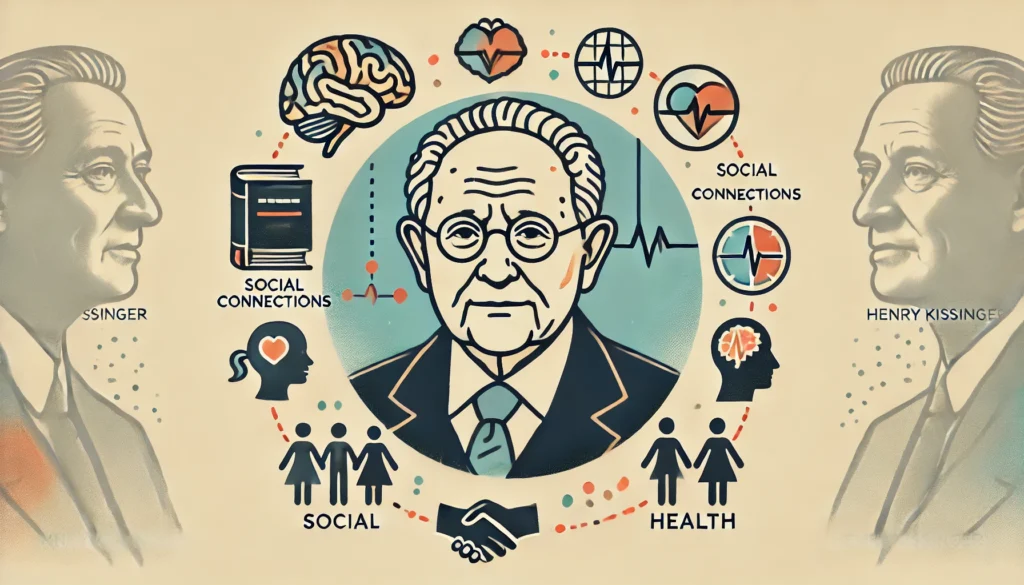
A sharp mind and social ties: The pillars of the Kissinger Method.
Why Intellectual Curiosity and Longevity Go Hand-in-Hand
Standard longevity advice focuses on “avoiding the bad”—bad fats, high calories, and sedentary behavior. However, Kissinger’s life was filled with irregular, high-fat, and high-calorie meals. According to his son, David Kissinger, the secret wasn’t his diet, but his never-ending curiosity.
Learning new things and solving global problems do more than just pass the time; they physically strengthen the brain. This mental stimulation builds new neural connections, effectively slowing down age-related cognitive decline. This is the ultimate “Active Leisure” that protects our internal systems from burning out.
Traditional Health vs. The Curiosity Method
| Feature | Traditional Longevity | Intellectual Longevity |
|---|---|---|
| Primary Focus | Physical Exercise | Mental Stimulation |
| Dietary Logic | Strict Limitation | Purpose-Driven Energy |
| Brain Impact | Reduced Stress | New Neural Connections |
Social Connections: The Social “Sotong”
Beyond the mind, intellectual curiosity and longevity are fueled by our relationships. Regularly meeting family and engaging with the world reduces loneliness and provides a “reason to live.” In East Asian medicine, this prevents the heart-spirit (Shen) from becoming scattered.
Eric Schmidt, former Google CEO, noted that Kissinger’s relentless hard work was a key factor in his long life. This sense of mission acts as a biological anchor. When you have a reason to get up in the morning, your body finds the metabolic will to keep going, even if you’ve skipped the gym for a decade.
The Role of Genetics and Environment
We must acknowledge that genes play a role—about 30% of the journey to 90 is inherited. Kissinger’s parents were also long-lived. However, the remaining 70% is up to your lifestyle. Choosing a path of lifelong learning and strong social ties is the most strategic way to leverage that 70%.