Intellectual curiosity and longevity are often more closely linked than we realize. While we are told that a strict diet and grueling exercise are the only paths to a long life, the story of Henry Kissinger suggests a more nuanced reality. If you dislike the treadmill, there is hope: a restless, engaged mind appears to be a meaningful biological asset of its own.
In Summary
- Purpose over pavement: Kissinger largely set aside standard health advice, yet lived to 100. His case suggests that sustained mental engagement and purpose can buffer some of the metabolic cost of an otherwise irregular lifestyle — though it is not a license to ignore diet and exercise.
- Cognitive circulation: intellectual curiosity keeps a steady flow of mental engagement, which in Korean medical terms helps prevent stagnation and keeps the Spirit (Shen) active and anchored.
- Subtraction of stress: orienting toward a larger purpose naturally supports the “Strategy of Subtraction,” removing the chronic, low-grade anxiety of over-analyzing every calorie and metric.
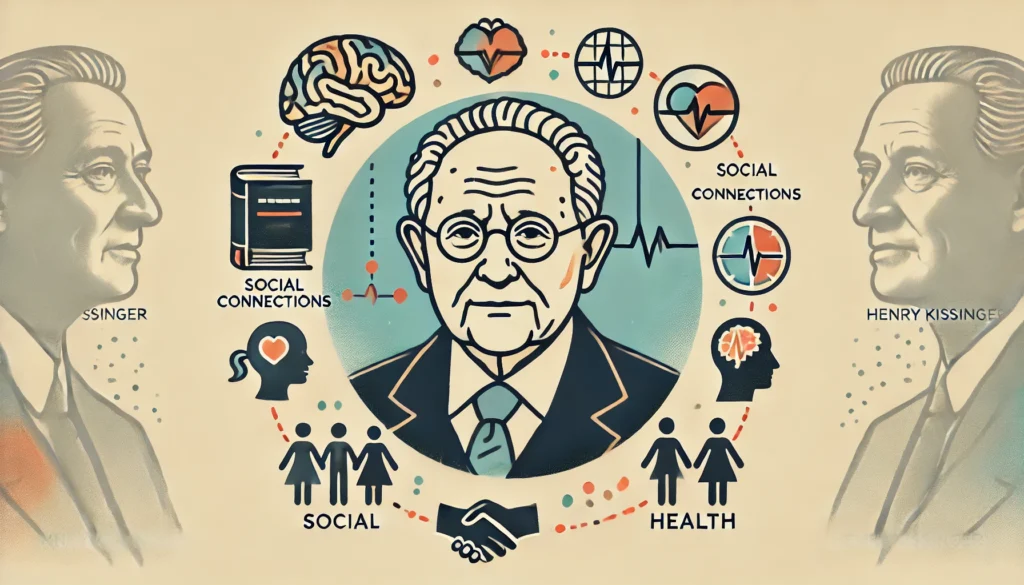
A sharp mind and social ties: the pillars of the Kissinger Method.
Why Intellectual Curiosity and Longevity Go Hand-in-Hand
Standard longevity advice focuses on “avoiding the bad” — bad fats, high calories, sedentary behavior. Kissinger’s life, by contrast, was filled with irregular, high-fat, high-calorie meals. According to his son, David Kissinger, the more important factor was not his diet but his never-ending curiosity.
Learning new things and working on difficult problems do more than pass the time; they help maintain the brain. Ongoing mental stimulation supports the formation of new neural connections and is associated with slower age-related cognitive decline. This is the kind of “active leisure” that helps protect our internal systems from burning out — a complement to diet and exercise, not a replacement for them.
Traditional Health vs. The Curiosity Method
| Feature | Traditional Longevity | Intellectual Longevity |
|---|---|---|
| Primary Focus | Physical Exercise | Mental Stimulation |
| Dietary Logic | Strict Limitation | Purpose-Driven Energy |
| Brain Impact | Reduced Stress | New Neural Connections |
Social Connections: The Social “Sotong”
Beyond the mind, intellectual curiosity and longevity are fueled by our relationships. Regularly meeting family and engaging with the world reduces loneliness and provides a reason to live. In East Asian medicine, this helps prevent the heart-spirit (Shen) from becoming scattered.
Eric Schmidt, former Google CEO, noted that Kissinger’s relentless engagement with his work was a notable feature of his long life. A sense of mission can act as a kind of biological anchor: when you have a reason to get up in the morning, the body more readily finds the metabolic will to keep going.
The Role of Genetics and Environment
Genes do play a role — a substantial portion of the path to very old age is inherited, and Kissinger’s parents were themselves long-lived. But much of the rest is shaped by lifestyle. Choosing a path of lifelong learning and strong social ties is one of the more strategic ways to make the most of the part that is within our control.
In Summary: Your Purpose Is Your Pulse
A long, healthy life is less a single formula than a tapestry of purpose. Diet, exercise, and stress management are essential tools — but intellectual curiosity and longevity sit close to the heart of the matter. When you find your own reason to live, the rest of the regimen becomes easier to sustain.
Deep Dive into Longevity Economics
Curious about how your environment and income affect your health? Read my analysis in The Economics of Longevity.
Related Reading:
Read the Original Insights in Korean
This article reflects the clinical observations and research perspectives of Professor Seungho Baek, Professor of Korean Medicine at Dongguk University College of Korean Medicine, specializing in Pathology and Oncology.
