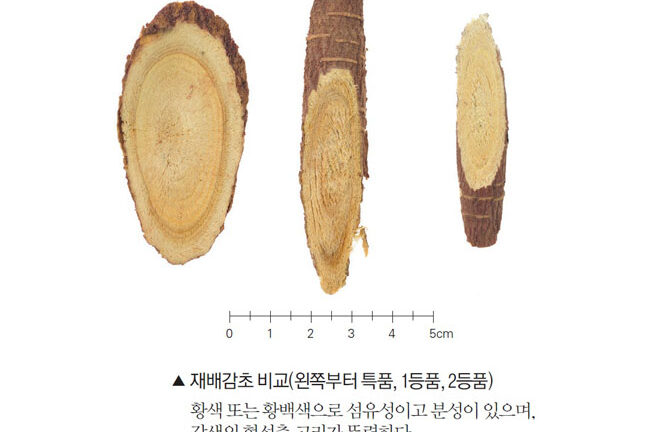
In Summary
- Raw Licorice (生甘草) clears heat and detoxifies. Roasted Licorice (炙甘草) warms and tonifies. They are clinical opposites — not variations of the same medicine.
- Licorice appears in more classical formulas than any other herb because its harmonizing function is structural, not decorative. Glycyrrhizin’s effect on drug metabolism makes this pharmacologically real.
- Classical tonification with Roasted Licorice assumed a frequently malnourished population. In an era of caloric surplus, this assumption must be actively reconsidered for each patient.
- The “surface flare, internal chill” pattern — exterior heat combined with digestive weakness — is a common constitutional disruption of sedentary digital life. Choosing the right Licorice preparation is one of the more precise interventions available for it.
Among the herbs I teach most carefully, Glycyrrhizae Radix — Licorice root, or Gancao (甘草) — occupies a paradoxical position. It is simultaneously the most commonly used herb in the classical pharmacopoeia and the most conceptually underestimated. Students and patients alike tend to think of it as sweetener, as buffer, as the herb that softens formulas. This is accurate but incomplete.
Licorice is a precision instrument. Its two preparations — raw and roasted — have opposite clinical vectors. Its harmonizing function has real pharmacological consequences. And its traditional indications require meaningful revision for the physiological realities of contemporary patients.
The Two Preparations: Opposite Directions from the Same Root
Raw Licorice (生甘草, Sheng Gancao) is used unprocessed. It is cool in nature, sweet in flavor, and primarily oriented toward clearing heat, detoxifying, and resolving inflammatory and toxic conditions in the upper and exterior portions of the body. Its primary indications include: throat inflammation, skin eruptions, toxic swellings, and as a moderating agent in formulations containing harsh or toxic herbs.
Roasted Licorice (炙甘草, Zhi Gancao) is honey-fried, which transforms its thermal nature from cool to warm. This processing shifts its clinical vector from clearing to tonifying — it now strengthens the Spleen and Stomach Qi, supplements the Middle Burner, and moderates spasm and urgency. Its primary indications include: digestive weakness, fatigue, palpitations from Heart Qi deficiency, and cramping from Blood deficiency.
The distinction is not subtle. Using Raw Licorice when Roasted is indicated will cool a patient who needs warming. Using Roasted when Raw is indicated risks consolidating heat that needs to be cleared.
This is why the clinical question is never simply “should I use Licorice?” but always “which Licorice, and why?”
1. The Harmonizer Function: More Than a Classical Metaphor
The classical texts describe Licorice as the “ambassador herb” (國老, Guolao) — the elder statesman who moderates conflict between other herbs in a formula, neutralizes toxicity, and ensures that the formula’s combined action is coherent rather than chaotic.
For a long time, Western pharmacologists viewed this as literary decoration. It is not.
Glycyrrhizin — Licorice’s primary bioactive compound — and its metabolite glycyrrhetinic acid are now known to modulate cytochrome P450 enzymes, the liver enzyme system responsible for metabolizing the majority of pharmaceutical drugs and many herbal compounds. This means that Licorice, when present in a formula, actively alters the bioavailability, metabolic rate, and duration of action of co-administered substances.
The practical implications are significant in both directions. In classical herb combinations, this modulation produces the synergistic effects that classical medicine observed empirically — Licorice making certain toxic herbs safer, or extending the therapeutic window of others. In contemporary integrative practice, it means that patients taking Licorice alongside pharmaceutical medications require careful monitoring for drug interactions.
There is a second safety consideration that belongs alongside the first. Glycyrrhizin, in excessive or prolonged use, can raise blood pressure and lower serum potassium through a pseudoaldosteronism effect. For this reason, sustained or high-dose Licorice is not suitable for people with hypertension, heart or kidney disease, low potassium, or during pregnancy, and is not something to self-administer at medicinal strength. This is precisely why preparation, dosage, and duration belong in the hands of a qualified clinician rather than being decided informally.
The harmonizer is real. It operates biochemically. Dismissing it as metaphor is a clinical error.
2. The Surface Flare, Internal Chill Pattern
In earlier articles on Fresh Ginger and the Thermodynamics of Longevity, I described the “Upper Heat, Lower Cold” pattern that characterizes the physiological state of many contemporary patients: cognitive overactivation and stress-driven heat in the upper body and exterior, combined with digestive weakness, cold extremities, and low metabolic energy in the interior and lower body.
Licorice addresses both poles of this pattern — but only if the correct preparation is chosen.
When the surface flare dominates — manifesting as facial heat, throat inflammation, skin reactivity, or inflammatory conditions exacerbated by stress — Raw Licorice is the appropriate preparation. It clears the exterior heat without burdening the already-weakened interior.
When the internal chill dominates — manifesting as chronic digestive weakness, fatigue, appetite loss, loose stools, and a sense of internal coldness despite surface stress — Roasted Licorice is indicated. It warms and tonifies the Middle Burner without driving additional heat to the already-inflamed exterior.
When both patterns are present simultaneously — which is common in patients with chronic stress, irregular eating, and sedentary work — the formula must be constructed carefully, often with both preparations used in different proportions, or with other herbs addressing each pole directly.
This is where constitutional assessment becomes essential. The same symptom cluster in a Soeum type and a Soyang type requires different interventions — and the Licorice preparation is one of the variables that shifts accordingly.
3. The Over-Nutrition Problem: Revising Classical Assumptions
Here I want to make a clinical argument that I consider genuinely important for contemporary practice — one that the classical literature does not address, because the problem did not exist when that literature was written.
Classical indications for Roasted Licorice were developed in the context of a population that was frequently malnourished, physically active, and metabolically lean. Tonification — building Qi, supplementing Blood, strengthening the Spleen — was nearly universally appropriate, because the underlying condition was almost always deficiency.
That assumption no longer holds for most patients in contemporary clinical practice.
A significant proportion of patients presenting with fatigue, digestive complaints, and the symptoms classically associated with Spleen Qi deficiency are not malnourished. They are calorically over-nourished, metabolically congested, and suffering from what Korean medicine would describe as Dampness-Heat accumulation — excess moisture and heat stagnating in the Middle Burner from overconsumption, sedentary lifestyle, and disrupted digestive rhythm.
For these patients, Roasted Licorice’s tonifying, consolidating action can worsen rather than resolve the underlying condition. Adding building energy to a system already congested with unconverted material is counterproductive. The Middle Burner does not need more resources — it needs better circulation of the resources it already has.
This requires a different prescription strategy entirely: less tonification, more activation of the Spleen’s transforming and transporting functions, and selective use of Raw Licorice where clearing is more appropriate than building.
The clinical error of applying classical tonification protocols to modern overfed, under-exercised patients is one I encounter regularly. It is not a failure of the classical framework — it is a failure to update that framework’s assumptions for a changed population.
4. Licorice in Formula Context: Why Removal Changes Everything
Because Licorice’s harmonizing function alters the bioavailability and interaction profile of other formula components, removing it from a classical formula does not simply reduce one ingredient — it changes the formula’s entire dynamic.
This is a clinical point that matters practically. Patients who self-administer individual herbs, or who purchase standardized extracts that have been “simplified” by removing Licorice for cost or palatability reasons, are not taking the same medicine as the classical formula intended. They are taking something different — and comparing outcomes to classical literature is not meaningful.
The same principle applies to the choice of preparation within a formula. A formula that calls for Roasted Licorice and receives Raw instead has been altered in its thermal and tonifying character, even if every other ingredient is correct.
Precision in herbal medicine is not pedantry. It is the difference between a formula that works and one that does not — or worse, one that produces the opposite of the intended effect.
Constitutional Summary
In Eight Constitution Medicine terms: Licorice in both preparations is most reliably beneficial for Soeum (少陰) constitutional types, whose tendency toward Middle Burner cold and Blood deficiency aligns with Licorice’s core indications. Soyang (少陽) types require caution with both preparations — Raw Licorice may be appropriate for clearing surface heat, but Roasted Licorice risks consolidating the Dampness-Heat to which Soyang constitutions are already prone.
The general clinical principle: when in doubt about preparation, a clinician leans toward Raw for patients with any sign of heat or inflammatory excess, and toward Roasted only when deficiency and cold are clearly the primary pattern — and only after confirming that the patient’s metabolic status genuinely requires tonification rather than activation, and that there is no blood-pressure, potassium, or other contraindication to sustained Licorice use.
This article reflects the clinical observations and teaching practice of Professor Seungho Baek, Professor of Korean Medicine at Dongguk University College of Korean Medicine, specializing in Pathology and Oncology.
